NONLINEAR SOC OPTIMake

可重复使用火箭在线轨迹优化 Online Trajectory Optimization for Reusable Rockets

从大范围时变非线性动力学到面向目标芯片的嵌入式求解器,为极速动态下降段提供精准、稳定的实时轨迹规划。 From large-envelope, time-varying nonlinear dynamics to target-specific embedded solvers, delivering precise and stable real-time trajectory planning for ultra-fast dynamic descent.

01 Vertical Rocket Landing

大范围时变非线性动力学下的精准定点着陆 Precision Landing Under Large-Envelope, Time-Varying Nonlinear Dynamics

行业挑战Industry Challenge

火箭一级垂直回收是典型的大范围、时变、强非线性动态过程。为了在燃料耗尽前安全定点着陆,系统必须实时规划最优轨迹。不仅要处理质量随燃料消耗骤降、气动变化等非线性动力学,还需严格满足姿态边界和推力锥二阶锥(SOC)约束。传统轨迹规划方案通常面临以下显著瓶颈:

Vertical recovery of a rocket first stage is a typical large-envelope, time-varying, strongly nonlinear dynamic process. To land safely and precisely before fuel depletion, the system must plan optimal trajectories in real time. It must handle nonlinear dynamics such as mass dropping sharply as fuel is consumed and changing aerodynamics, while strictly satisfying attitude bounds and thrust-cone second-order cone (SOC) constraints. Conventional trajectory planning approaches typically face the following major bottlenecks:
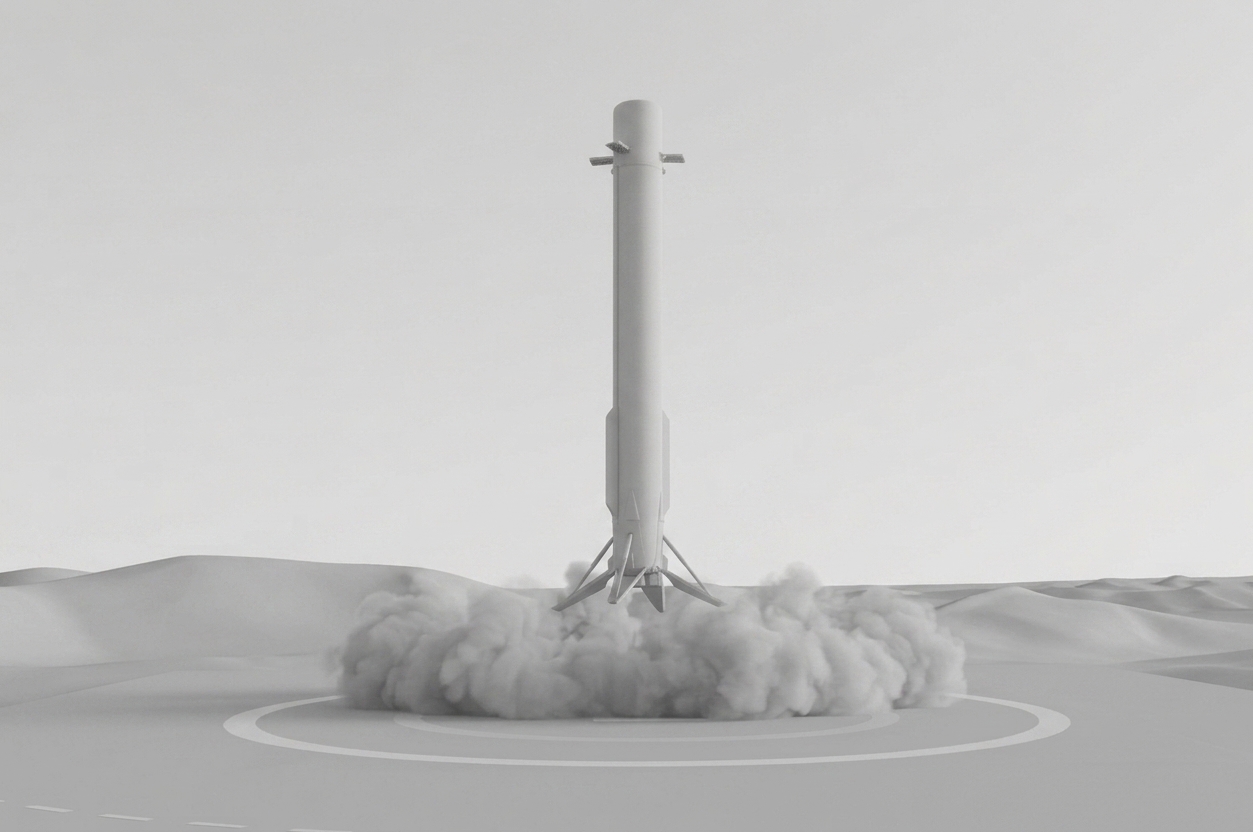
Reusable rocket vertical landing
无损建模Lossless Modeling
Nonlinear + SOC
自动代码生成Code Generation
Embedded C
毫秒级求解Millisecond Solving
芯片级优化Chip-Optimized
01

计算密集特性与箭载算力不足的矛盾Compute-Intensive Optimization vs. Limited Onboard Computing

在线数值优化求解属于计算密集型任务,而箭载宇航级嵌入式芯片受设计要求限制,算力往往十分有限。开源求解器在这类硬件上难以实施在线计算,传统方案只能选择“在大幅简化模型上实施低精度在线规划”“离线弹道规划 + 在线局部跟踪”。这一妥协严重削弱了系统应对强侧风、发动机推力衰减等突发摄动的动态调节能力,从根本上制约火箭 GNC 系统的整体抗干扰能力与最终着陆精度。

Online numerical optimization is compute intensive, while aerospace-grade onboard processors provide limited performance under stringent design constraints. Open-source solvers struggle to execute online on this hardware, forcing conventional systems to choose either low-accuracy online planning with heavily simplified models or offline trajectory design plus local online tracking. This compromise weakens dynamic response to sudden disturbances such as strong crosswinds and engine-thrust degradation, fundamentally limiting GNC robustness and landing accuracy.

02

非凸问题的降维妥协与收敛危机Nonconvex Simplification and Convergence Risk

火箭真实动力学模型表现为高度非凸非线性。在尝试引入在线优化的传统处理中,工程师往往需要将原始问题大幅简化并线性化为简单凸问题。第三方凸优化求解器通常只能处理线性二阶锥,无法直接求解本质上的非凸非线性模型。这种近似处理不仅在规划层限制了火箭的控制边界与机动能力,而且在复杂边界工况下极易引发求解器发散,带来收敛性风险。

Real rocket dynamics are highly nonconvex and nonlinear. Conventional attempts at online optimization require engineers to simplify and linearize the original problem into a basic convex formulation. Third-party convex optimization solvers generally handle only linear second-order cones and cannot directly solve the underlying nonconvex nonlinear model. This approximation restricts the rocket's control envelope and maneuverability at the planning level while introducing solver-divergence and convergence risks near complex operating boundaries.

OPTIMake Solution

OPTIMake 解决方案与核心优势OPTIMake Solution and Core Advantages

OPTIMake 致力于实现从高维数学描述到嵌入式 C 代码的端到端自动化。通过充分发掘运载器的非线性动力学特性,为火箭在线回收提供严苛的硬实时算力与算法保障:

OPTIMake delivers end-to-end automation from high-dimensional mathematical descriptions to embedded C code. By fully exploiting the launch vehicle's nonlinear dynamic characteristics, it provides the hard real-time computing performance and algorithmic assurance required for online rocket recovery:

OPTIMake code generation workflow Symbolic modeling, automatic solver code generation, and millisecond real-time solving. OPTIMake Workflow 1 SYMBOLIC MODELING USER COMPUTER min l(v) s.t. f(v) = 0 g(v) ≥ 0 User-defined OCP problem 2 CODE GENERATION OPTIMake Server Solver Code Generator Problem & hardware customized 3 REAL-TIME SOLVING x0 = p INPUT PARAMETERS + + ALGORITHMPROBLEMHARDWARE Millisecond execution
01 Code Generation

高层级建模与核心代码全自动生成High-Level Modeling and Automatic Core Code Generation

  • 直观数学描述:研发人员只需输入连续动力学方程、边界条件及混合约束。
  • 自动建模处理:自动完成符号推导、模型离散化与求解器算法的定制化构建,避免繁复手工推导。
  • 缩短开发周期:模型变更无需推倒重来,将底层算法开发从数周压缩至数小时。
  • Intuitive mathematical description: Engineers enter continuous dynamics, boundary conditions, and hybrid constraints directly.
  • Automated modeling: Symbolic differentiation, model discretization, and solver construction run automatically without tedious manual derivation.
  • Shorter development cycles: Model changes no longer require a complete re-derivation, reducing low-level development from weeks to hours.
OPTIMake nonlinear second-order cone modeling interface Python code defines nonlinear differential equations and a second-order cone thrust constraint. Γ ρ₂ ρ₁ Tc ||Tc||₂ ≤ Tmax rocket_landing.py ode = differential_equation( state=[x,y,theta,vx,vy,dtheta,mass,tf], state_dot=dxdt, stepsize=ts, discretization_method='erk4') prob.equality(ode) soc = second_order_cone_inequality(thrust_max,[tx,ty,tz]) prob.inequality(soc)
02 Lossless Modeling

原生支持 Nonlinear + SOC 混合建模Native Nonlinear + SOC Hybrid Modeling

  • 连续动力学接口:通过 differential_equation 定义状态转移方程,并指定离散步长与离散方法自动完成离散化。
  • 完整物理建模:原生联合求解非凸非线性约束与二阶锥(SOC)约束,无需强制降维。
  • 高性能求解内核:针对优化问题定制的嵌入式IPM与SQP/SCP算法,增强收敛稳定性。
  • 释放控制边界:在规划层保留真实非线性特性,避免因简化约束造成控制能力损耗。
  • Continuous-dynamics interface: Define state-transition equations with differential_equation, then specify the step size and discretization method for automatic discretization.
  • Full-fidelity physics: Jointly solve nonconvex nonlinear and SOC constraints without forced dimensional reduction.
  • High-performance solver core: Embedded IPM and SQP/SCP algorithms tailored to the optimization problem improve convergence stability.
  • Expanded control envelope: Preserve real nonlinear behavior at the planning level without losing control authority to simplified constraints.
One-dimensional and two-dimensional aerodynamic lookup tables A cubic one-dimensional interpolation curve and a two-dimensional thrust heatmap above compact Python interface examples. 1D · AERODYNAMIC COEFFICIENT Mach NumberCD₀ 2D · THRUST LOOKUP TABLE Thrust of Bryson Aircraft 0.00.40.81.21.61.805k10k15k20k45200 Mach NumberAltitude (m) aerodynamic_tables.py lt_CD0 = lookup_table(name='CD0', points=Mach, values=CD0, method='cubic') lt_T = lookup_table(name='T', points=[Mach, altitude], values=thrust, method='cubic')
03 Lookup Tables

原生内嵌气动插值表,极速耦合求解Native Aerodynamic Lookup Tables for Ultra-Fast Coupled Solving

  • 原生表格支持:在底层架构与用户接口中直接嵌入多维气动插值表(Lookup Tables)。
  • 深度耦合求解:气动插值与求解器优化算法高效协同,实现不同速度范围内气动参数的平滑、连续过渡。
  • 消除额外时延:省去“外部插值 + 参数传递”,简化调用并降低计算与通信开销。
  • Native table support: Embed multidimensional aerodynamic lookup tables directly in the core architecture and user interface.
  • Deeply coupled solving: Aerodynamic interpolation works efficiently together with the solver's optimization algorithms, giving smooth, continuous transitions of aerodynamic parameters across different velocity ranges.
  • No external latency: Remove external interpolation and parameter transfer to simplify integration and reduce compute and communication overhead.
Connected phases and optimized engine switching times n ENGINES TRANSITION m ENGINES t₁ optimizedt₂ optimized time
04 Multi-Phase Optimization

灵活适配多阶段最优控制与开关机时间优化Flexible Multi-Phase Optimal Control and Switching-Time Optimization

  • 多阶段建模:灵活表达变推力、变发动机工作数量及阶段间动态衔接。
  • 控制曲线优化:在线输出满足严苛物理约束且燃料消耗最优的连续控制 Profile。
  • 切换时间求解:直接优化发动机开关机与阶段衔接时间点,无需外部枚举。
  • Multi-phase modeling: Express variable thrust, changing engine counts, and dynamic transitions between phases.
  • Control-profile optimization: Produce fuel-optimal continuous profiles online while satisfying demanding physical constraints.
  • Switching-time solution: Directly optimize engine start, shutdown, and phase-transition times without external enumeration.
Target-specific solver performance comparison Benchmark with nine variables, 101 discretization points, 10,000 cold-start samples, on AMD Ryzen 9950x under WSL2 using GCC O2. SOLVER BENCHMARK OCP SCALE 9 variables × 101 discretization points SAMPLES 100 × 100 = 10,000 · all cold starts PLATFORM AMD Ryzen 9950x · WSL2 · GCC O2 ~43 ms 1.1 ms Generic OPTIMake 38× FASTER
05 Real-Time

面向目标芯片的极致性能优化Extreme Performance Optimization for Target Hardware

  • 芯片级定制:针对算力和内存有限的箭载SoC,在矩阵计算层面进行算子级代码优化。
  • 突破算力瓶颈:通过指令、内存与数值内核优化,在有限算力上实施高保真在线规划。
  • 强化 GNC 韧性:为强侧风、推力衰减等突发摄动保留实时重规划与动态纠偏能力。
  • Chip-level tailoring: Operator-level code optimization at the matrix-computation layer, targeting onboard SoCs with limited compute and memory.
  • Break the compute bottleneck: Apply instruction, memory, and numerical-kernel optimization for high-fidelity online planning on limited hardware.
  • Strengthen GNC resilience: Preserve real-time replanning and dynamic correction under crosswinds, thrust degradation, and other disturbances.

让高保真在线优化真正运行在箭载芯片上 Run High-Fidelity Online Optimization on Real Onboard Hardware

我们提供试用版本、演示案例与技术支持:从非线性混合建模、多阶段控制到芯片级 C 代码生成,构建更高抗干扰能力与着陆精度的火箭 GNC 系统。 We provide trial versions, demo cases, and technical support: from nonlinear hybrid modeling and multi-phase control to chip-level C code generation, build rocket GNC systems with greater disturbance rejection and landing accuracy.

联系我们Contact us