REAL-TIME NONLINEAR OPTIMAKE

时间最优轨迹规划 Time-Optimal Trajectory Planning

在电机能力边界内跑出最短节拍,同时抑制冲击与振动。 Achieve the shortest cycle time within actuator limits while suppressing shock and vibration.

Time-Optimal Planning

同一条路径,如何跑得更快、更稳 Same Path, Faster and Smoother Execution

任务场景The Task

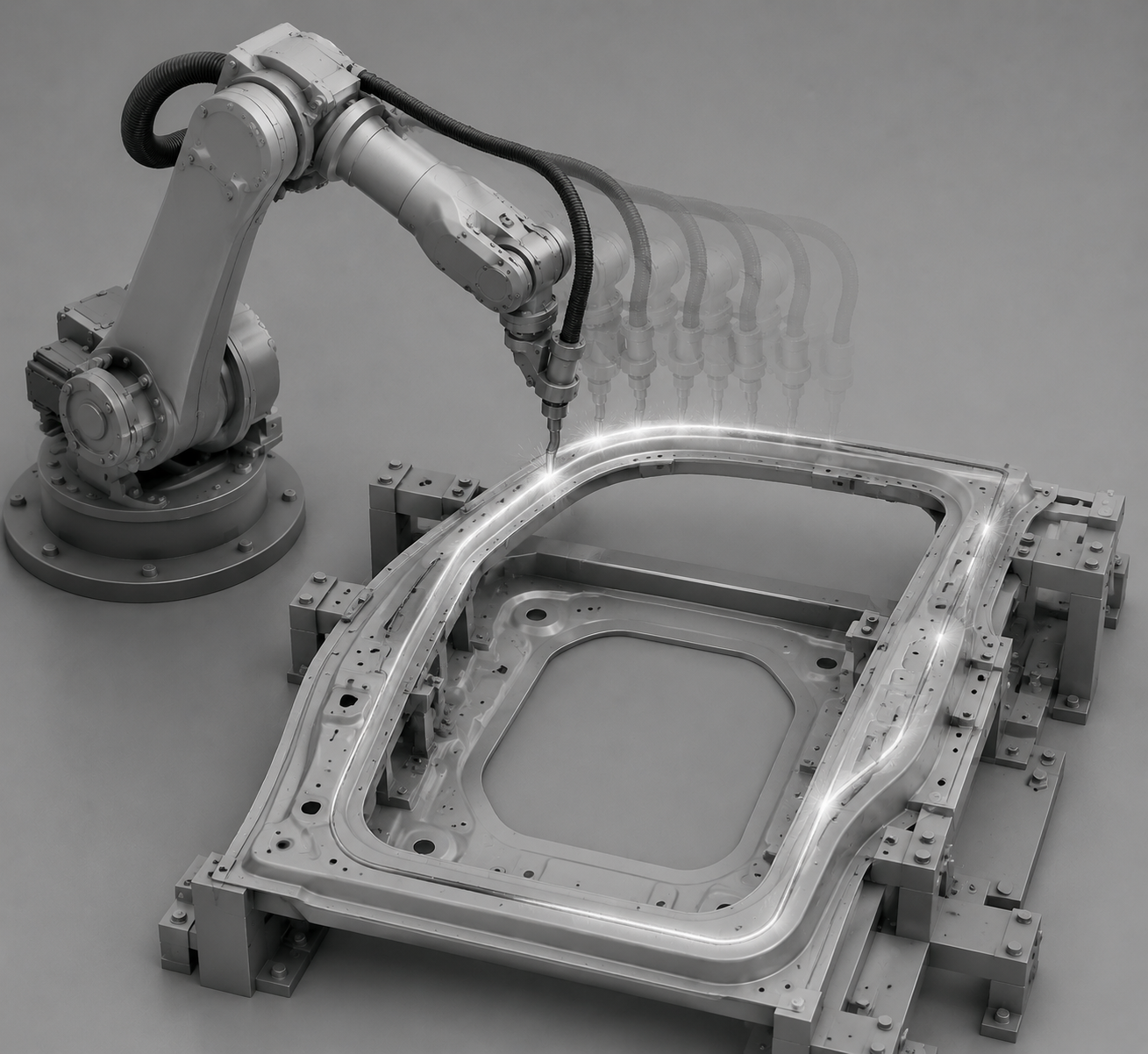
路径决定“走哪里”,时间最优规划决定“走多快”:在速度、加速度、力矩、冲击(jerk)等能力边界内,为已有路径分配最快的速度曲线。

  • 节拍就是产能:分拣、装配、打磨中省下的每一秒都直接折算成产出。
  • 快而不抖:过大的冲击带来振动与机械磨损,影响精度和寿命。
  • 在线调整:工件、负载、路径随时变化,速度曲线需要随时重算。

The path decides where to go; time-optimal planning decides how fast, assigning the fastest velocity profile to an existing path within velocity, acceleration, torque, and jerk limits.

  • Cycle time is throughput: every second saved in sorting, assembly, or polishing converts directly into output.
  • Fast but smooth: excessive jerk causes vibration and wear that hurt accuracy and lifetime.
  • Online updates: workpieces, payloads, and paths change constantly, so profiles must be recomputed on the fly.
Time-Optimal Planning
μs 级求解μs-Level Solving
多轴机械臂实时求解Real-time solving for multi-axis arms
线性扩展Linear Scaling
求解耗时线性增长Solve time grows linearly
非线性约束Nonlinear Constraints
含 jerk 约束求解Solving with jerk constraints
01 Real-Time

毫秒级完成,可在线随时重规划 Millisecond Solves Enable Continuous Online Replanning

在典型x86计算平台上,101 个路径点的时间最优规划问题, 6 轴机械臂的求解耗时约 0.31 ms, 7 轴机械臂的求解耗时约 0.34 ms。

速度曲线不再是离线预计算的产物:负载变化、路径微调、临时降速都可以在运行中即时重算。

On a typical x86 platform, time-optimal planning for a 6-axis arm with 101 path points solves in about 0.31 ms; a 7-axis problem with 101 path points solves in about 0.34 ms.

Velocity profiles are no longer offline artifacts—payload changes, path edits, and temporary slowdowns can all be recomputed during operation.

02 Scalability

求解耗时随轴数与路径点数线性扩展,换机型只改参数 Linear Scaling in Axes and Path Points; New Robots Need Only New Parameters

求解规模随路径点数与关节数线性增长,从 6 轴机械臂扩展到多轴、双臂或冗余机构时性能可预期。

同一份模型描述换上新的能力参数即可复用于不同机型与工况,无需重写算法。

Problem cost grows linearly with path points and joints, so performance stays predictable when moving from a 6-axis arm to multi-axis, dual-arm, or redundant mechanisms.

The same model description is reused across robots and operating conditions by swapping capability parameters—no algorithm rewrite required.

03 Nonlinear Constraints

原生支持 jerk 等非线性非凸约束 Native Support for Nonlinear, Non-Convex Constraints Such as Jerk

传统方法为了可解性往往要把 jerk 这类非凸约束近似甚至省略,代价是残余振动与机械磨损;OPTIMake 支持原始非线性非凸问题的求解,无需近似。

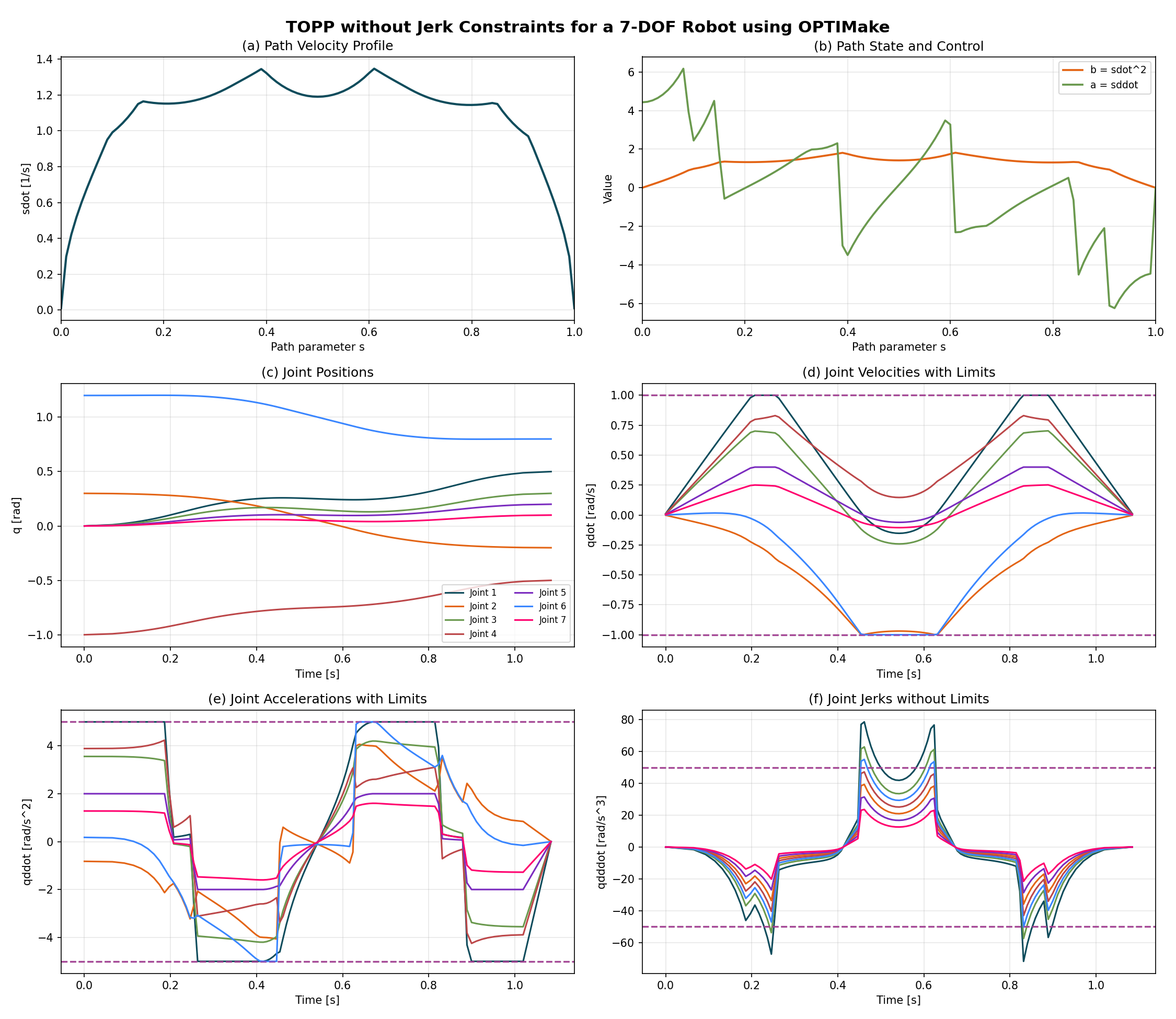
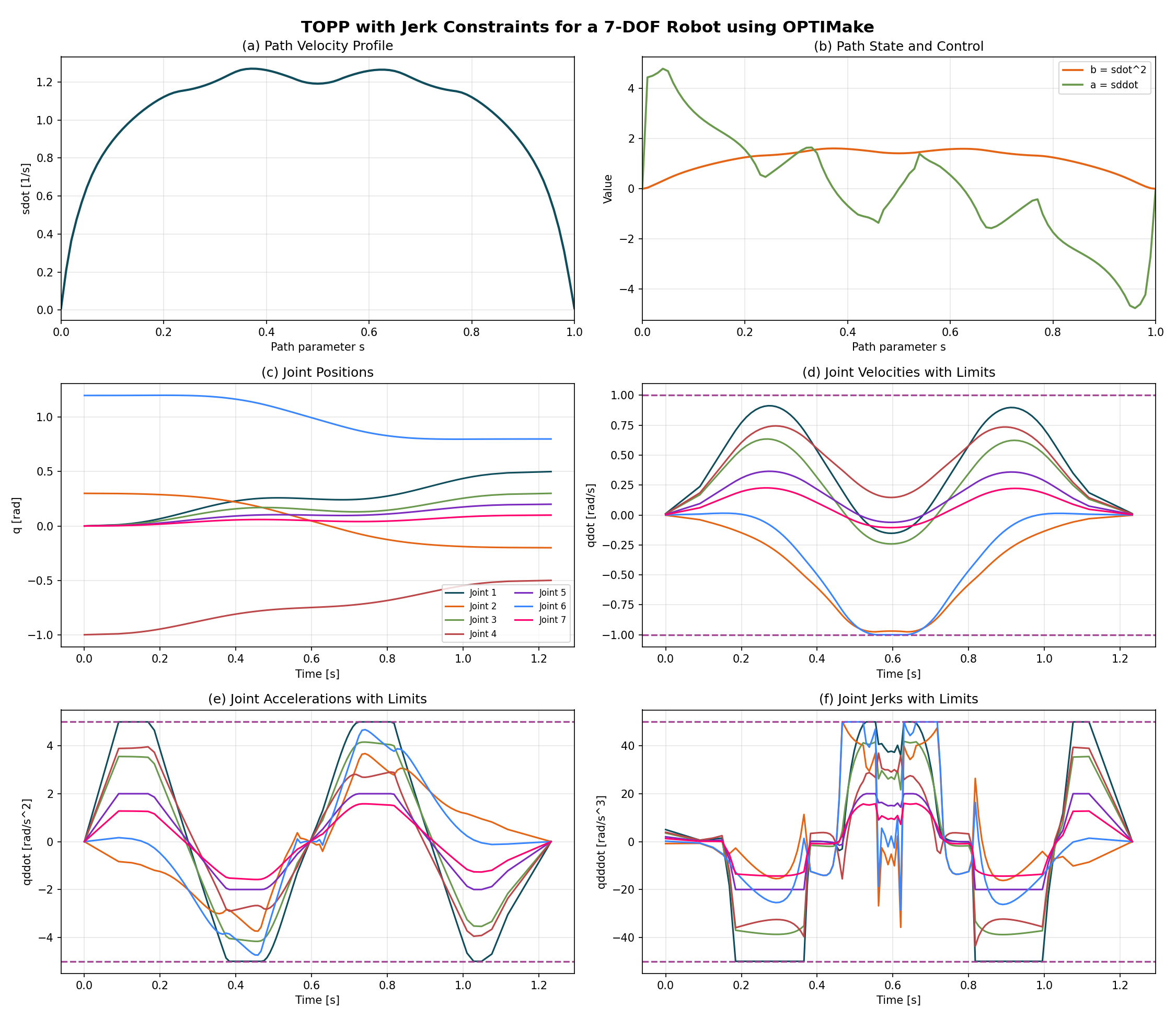
在 7 轴示例中加入 jerk 约束后运动明显更平滑,而总运行时间仅从 1.08 s 增加到 1.23 s——用极小的节拍代价换取更好的运动品质。

速度、加速度、力矩、jerk 以及自定义的非线性能力曲线都可以自由组合。

Conventional methods approximate or drop non-convex constraints such as jerk for tractability, at the cost of residual vibration and wear. Here they are solved in their original form.

In a 7-axis example, adding jerk limits makes the motion clearly smoother while traversal time grows only from 1.08 s to 1.23 s—a small cycle-time cost for a large gain in motion quality.

Velocity, acceleration, torque, jerk, and custom nonlinear capability curves can be combined freely.

7-axis result without jerk constraints
无 jerk 约束Without jerk constraints
7-axis result with jerk constraints
有 jerk 约束With jerk constraints

想在您的机器人上验证效果? Want to validate this on your robot?

我们提供试用版本、演示案例与技术支持 We provide trial versions, demo cases, and technical support.

联系我们Contact us