Trajectory Tracking Control Problem
In this example, we demonstrate the modeling and solving process for a vehicle trajectory tracking control problem.
Additionally, for this type of problem that requires continuous solving, we demonstrate how to accelerate solving:
- How to use warm start to reduce the number of iterations
- The effect of different barrier parameters on solving accuracy and number of iterations
Problem Description
We constructed a closed-loop simulation with the following settings:
- The reference trajectory is a straight line parallel to the x-axis with a speed of 1 m/s
- When , ; when ,
- The vehicle's initial state is
- The closed-loop control frequency is 20 Hz, simulation time is 12 s
The objective function of the trajectory tracking controller is to minimize the vehicle's tracking error (discretized into 20 time points):
Additionally, we need to consider the following constraints:
- Vehicle kinematic constraints (time step of 0.2 s):
- bound constraints:
- boundary conditions:
Results
Closed-loop control results are as follows:
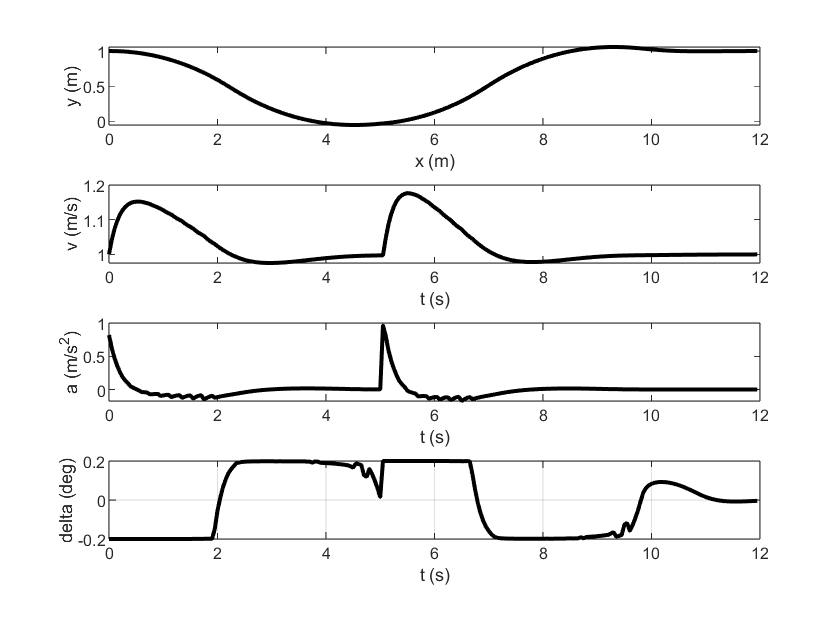
Warm Start
Warm start can help the solver converge and reduce the number of iterations. OPTIMake's warm start includes the following operations:
- Setting the initial guess of variables in the workspace
- Setting the
try_warm_start_barrierparameter in options
For this type of problem that requires continuous solving, we can use warm start to accelerate solving.
Here, we discuss the effect of the try_warm_start_barrier parameter on the number of iterations.
Below is a reference for setting this parameter (see Solver Interface for details):
option.try_warm_start_barrier = 1;
Below is the iteration count comparison with and without try_warm_start_barrier (thin blue line is enabled, thick black line is disabled):
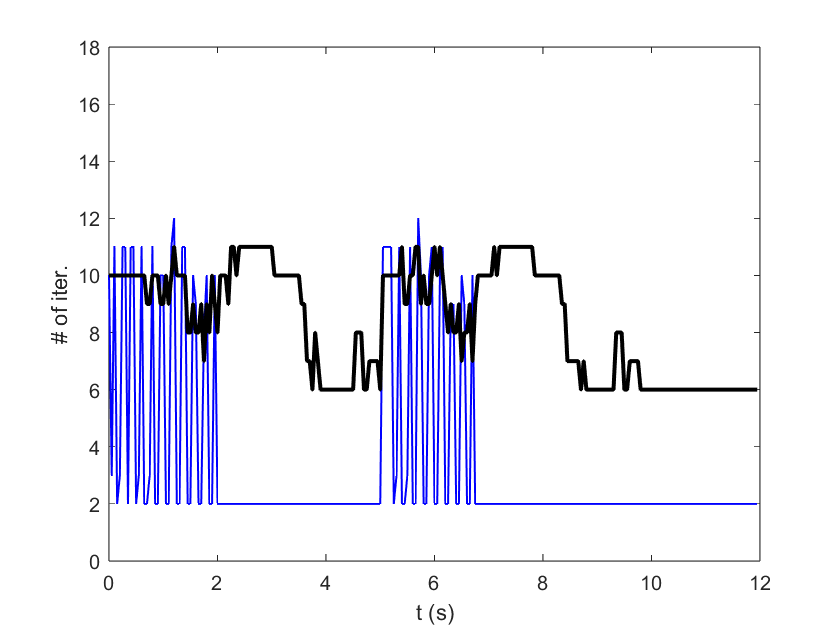
As can be seen, after enabling this option:
- When warm start succeeds, the number of iterations can be significantly reduced
- When warm start fails, the number of iterations is only 1 more than without this option
Barrier Parameter
When the solver parameter in code generation is set to 'pdipm', OPTIMake uses the primal-dual interior point method.
Simply put, the constraint is approximated by a barrier function:
The target value of the barrier function parameter is set via the barrier_target parameter. During solving, gradually changes from the barrier_init parameter to the barrier_target parameter.
The smaller the barrier_target value, the more accurate the constraint approximation, but the number of solving iterations also increases.
Here, we show the closed-loop simulation results and iteration count comparison under different barrier_target values.
Closed-loop simulation results comparison under different barrier_target values:
- barrier_target=1e-2
- barrier_target=1e-4
- barrier_target=1e-6
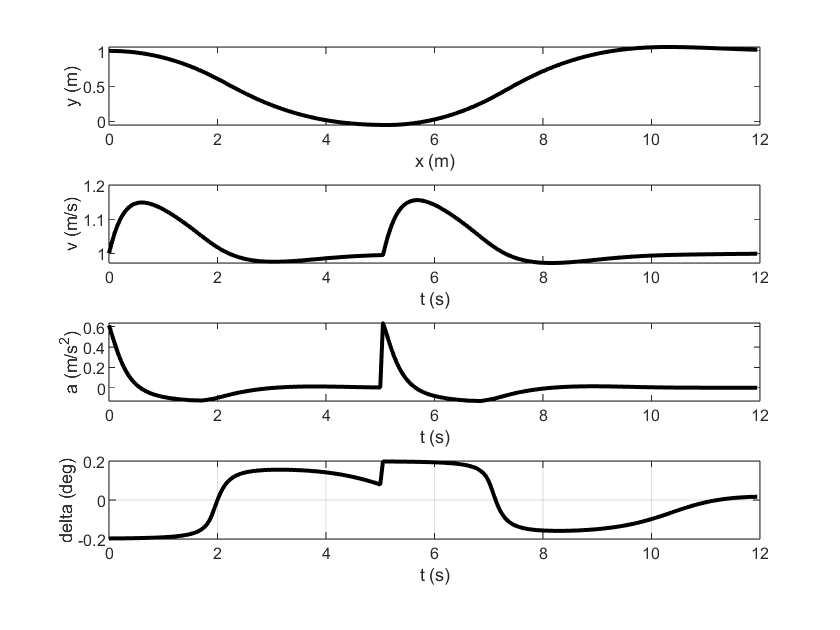
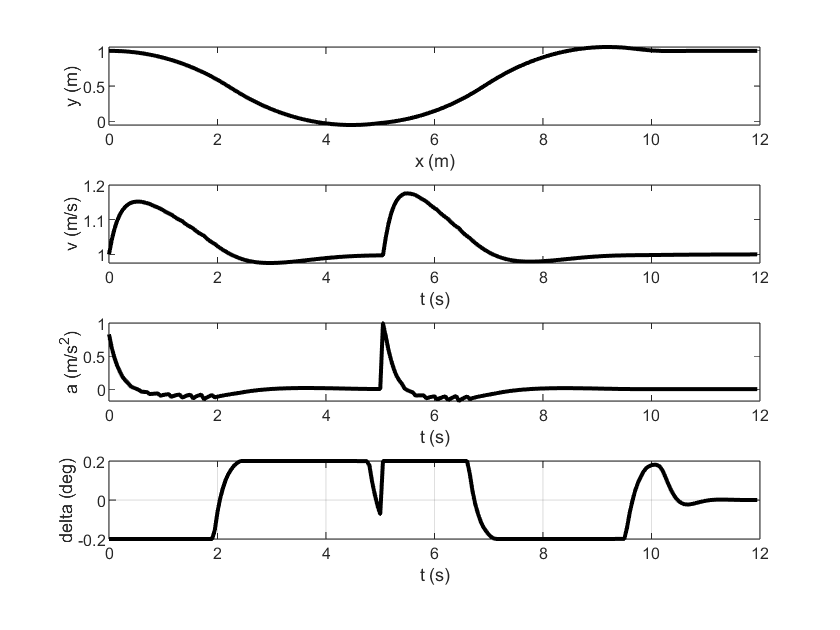
Iteration count comparison under different barrier_target values (thin blue line is with try_warm_start_barrier enabled, thick black line is with try_warm_start_barrier disabled):
- barrier_target=1e-2
- barrier_target=1e-4
- barrier_target=1e-6
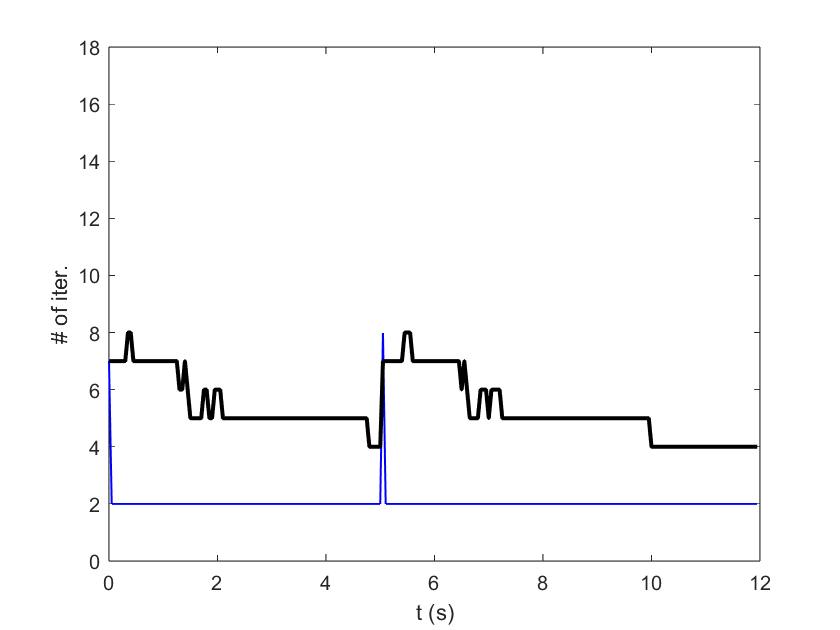
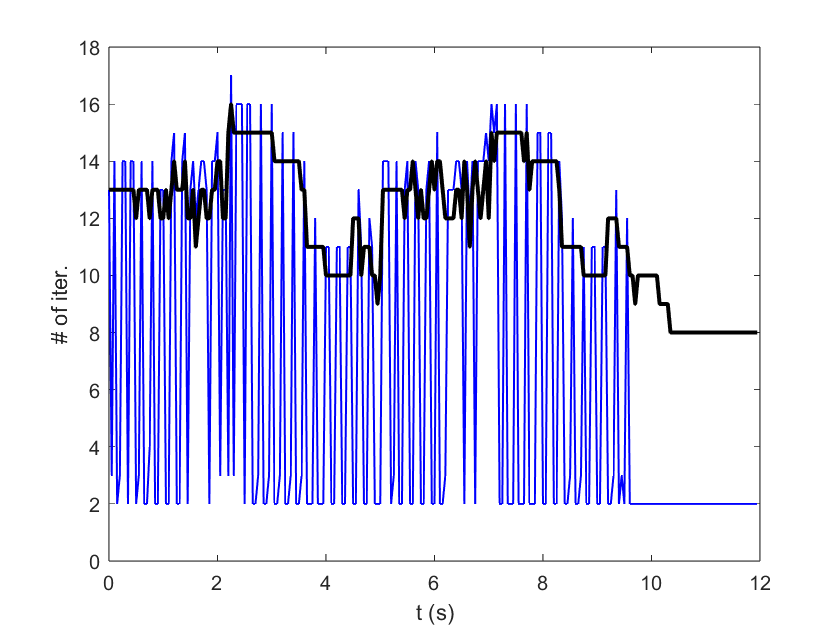
As can be seen, the effect of barrier_target is as follows:
- When
barrier_target=1e-2, the number of iterations is the smallest, the warm start success rate is the highest, and the computation time (proportional to iteration count) is the lowest. However, the control variable is far from the bound constraints, resulting in lower accuracy - When
barrier_target=1e-6, the number of iterations is the largest, the warm start success rate is the lowest, and the computation time (proportional to iteration count) is the highest. However, the control variable is close to the bound constraints, resulting in the highest accuracy
In practice, the barrier_target value should be chosen based on specific requirements.
Appendix
The modeling code for the trajectory tracking controller is as follows:
prob = multi_stage_problem('traj_tracking', 20)

xweight, yweight, vweight = prob.parameters(['xweight', 'yweight', 'vweight'], stage_dependent=False)
x0, y0, phi0, v0 = prob.parameters(['x0', 'y0', 'phi0', 'v0'], stage_dependent=False)
vref, yref = prob.parameters(['vref', 'yref'], stage_dependent=False)
xref = prob.parameter('xref', stage_dependent=True)

x = prob.variable('x')
y = prob.variable('y')
phi = prob.variable('phi')
delta = prob.variable('delta', hard_lowerbound=-0.2, hard_upperbound=0.2)
v = prob.variable('v')
a = prob.variable('a', hard_lowerbound=-1.0, hard_upperbound=1.0)

obj = general_objective(xweight * (x - xref)**2 + yweight * (y - yref)**2 + vweight * (v - vref)**2)
prob.objective(obj)

""" ode """
length = 1.0
ode = differential_equation(
    state=[x, y, phi, v],
    state_dot=[v * cos(phi), v * sin(phi), v * tan(delta) / length, a],
    stepsize=0.2,
    discretization_method='erk4')
prob.equality(ode)

seq = general_equality([x - x0, y - y0, phi - phi0, v - v0])
prob.start_equality(seq)

option = codegen_option()
codegen = code_generator()
codegen.codegen(prob, option)
The trajectory tracking closed-loop simulation code is as follows:
#include "traj_tracking_prob.h"
#include "traj_tracking_solver.h"
#include <stdio.h>

void simulate(const double u[2], const double x[4], const double dt, double x_next[4])
{
    /* simulate the system */
    const double a = u[0];
    const double delta = u[1];

    const double phi = x[2];
    const double v = x[3];

    x_next[0] = x[0] + v * cos(phi) * dt;
    x_next[1] = x[1] + v * sin(phi) * dt;
    x_next[2] = phi + v * tan(delta) / 1.0 * dt;
    x_next[3] = v + a * dt;
}


int main(void)
{
    Traj_tracking_Problem prob;
    Traj_tracking_Option option;
    Traj_tracking_WorkSpace ws;
    Traj_tracking_Output output;
    traj_tracking_init(&prob, &option, &ws);

    const double vref = 1.0;
    /* params */
    prob.param[TRAJ_TRACKING_PARAM_XWEIGHT] = 1.0;
    prob.param[TRAJ_TRACKING_PARAM_YWEIGHT] = 1.0;
    prob.param[TRAJ_TRACKING_PARAM_VWEIGHT] = 1.0;

    // initial state
    prob.param[TRAJ_TRACKING_PARAM_X0] = 0.0;
    prob.param[TRAJ_TRACKING_PARAM_Y0] = 1.0;
    prob.param[TRAJ_TRACKING_PARAM_PHI0] = 0.0;
    prob.param[TRAJ_TRACKING_PARAM_V0] = vref;

    // reference trajectory
    prob.param[TRAJ_TRACKING_PARAM_VREF] = vref;

    /* option */
    option.print_level = 0;
    option.try_warm_start_barrier = 1;
    option.barrier_target = 1e-6;

    const double ts_sim = 0.05;
    const double sim_length = 12.0;
    const double ts_discretization = 0.2;
    for (size_t sim_step = 0; sim_step < (size_t)(sim_length / ts_sim); sim_step++) {
        // update reference trajectory
        const double time = (double)sim_step * ts_sim;
        if (time > 5.0) {
            prob.param[TRAJ_TRACKING_PARAM_YREF] = 1.0;
        } else {
            prob.param[TRAJ_TRACKING_PARAM_YREF] = 0.0;
        }
        for (size_t i = 0; i < TRAJ_TRACKING_DIM_N; i++) {
            prob.param_stage[i][TRAJ_TRACKING_PARAM_STAGE_XREF] = vref * time + (double)i * ts_discretization;
        }

        // solve
        traj_tracking_solve(&prob, &option, &ws, &output);

        // simulate
        double u[2];
        double x[4];
        double x_next[4];
        u[0] = output.primal.var[0][TRAJ_TRACKING_VAR_A];
        u[1] = output.primal.var[0][TRAJ_TRACKING_VAR_DELTA];
        x[0] = prob.param[TRAJ_TRACKING_PARAM_X0];
        x[1] = prob.param[TRAJ_TRACKING_PARAM_Y0];
        x[2] = prob.param[TRAJ_TRACKING_PARAM_PHI0];
        x[3] = prob.param[TRAJ_TRACKING_PARAM_V0];
        simulate(u, x, ts_sim, x_next);

        // update initial state
        prob.param[TRAJ_TRACKING_PARAM_X0] = x_next[0];
        prob.param[TRAJ_TRACKING_PARAM_Y0] = x_next[1];
        prob.param[TRAJ_TRACKING_PARAM_PHI0] = x_next[2];
        prob.param[TRAJ_TRACKING_PARAM_V0] = x_next[3];

        printf("time %f: %f, %f, %f, %f, %f, %f;\n", time, x[0], x[1], x[2], x[3], u[0], u[1]);
    }

    return 0;
}