Reusable Launch Vehicle Entry
Problem Description
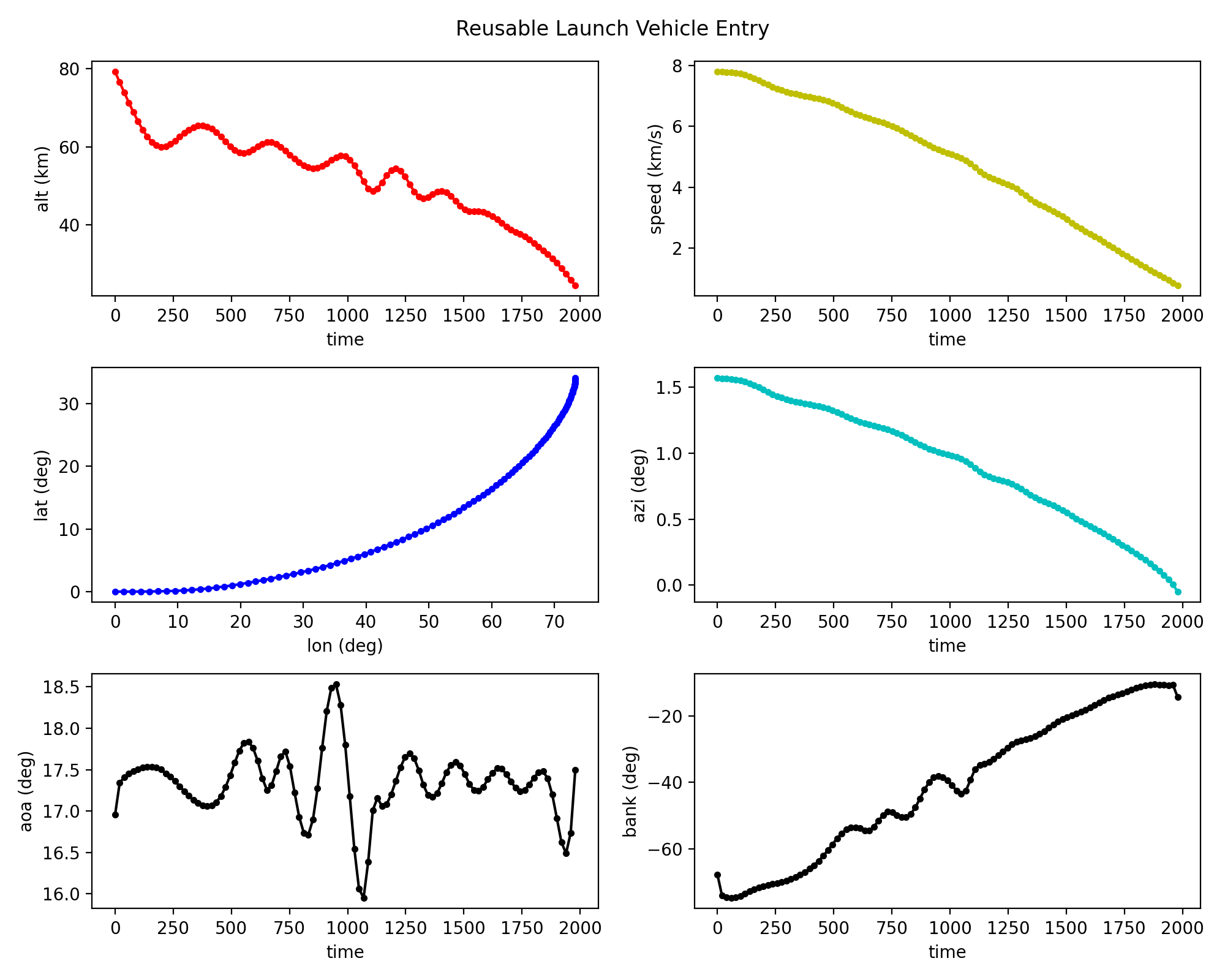
Consider the following optimal control problem of maximizing the crossrange during the atmospheric entry of a reusable launch vehicle and taken verbatim from Ref [1]. Minimize the cost functional and subject to the dynamic constraints,
and the boundary conditions:
Further details of this problem, including the aerodynamic model, can be found in Ref. The code for solving this problem is shown below.
For aerospace vehicles, aerodynamic coefficients generally vary with environmental factors such as speed and altitude. OPTIMake will provide dedicated LookupTable function support for this type of input, enabling efficient integration with the solver.
Modeling
# --------------- Reusable Launch Vehicle Entry Example --------------- #
# This example is taken varbatim from the following reference:          #
# Practial Methods for Optimal Control and Estimation Using Nonlinear   #
# Programming. SIAM Press, Philadelphia, 2009                           #
# --------------------------------------------------------------------- #

NN = 100
prob = multi_stage_problem('reentry', NN + 1)

cft2m = 0.3048 # cf to m
cft2km = cft2m / 1000 # cf to km
cslug2kg = 14.5939029

""" Provide Auxiliary Data for Problem """
Re = 6371203.92 # Equatorial Radius of Earth (m)
S = 249.9091776 # Vehicle Reference Area (mˆ2)
cl = [-0.2070, 1.6756] # Parameters for Lift Coefficient
cd = [0.0785, -0.3529, 2.0400] # Parameters for Drag Coefficient
b = [0.07854, -0.061592, 0.00621408] # Parameters for Heat Rate Model
al = [-0.20704, 0.029244] # Parameters for Heat Rate Model
rho0 = 1.225570827014494 # Sea Level Atmospheric Density (kg/mˆ3)
mu = 3.986031954093051e14 # Earth Gravitational Parameter (mˆ3/sˆ2)
mass = 92079.2525560557 # Vehicle Mass (kg)

""" Boundary Conditions """
rad0, lon0, lat0, speed0, fpa0, azi0 = prob.parameters(['rad0', 'lon0', 'lat0', 'speed0', 'fpa0', 'azi0'],  stage_dependent=False)
radf, speedf, fpaf, azif = prob.parameters(['radf', 'speedf', 'fpaf', 'azif'],  stage_dependent=False)

H = prob.parameters(['H'],  stage_dependent=False)
# H = 7254.24 # Density Scale Height (m)

""" Limits on Variables """
tfMin, tfMax = 1.0, 3000.0
radMin, radMax = Re, rad0
lonMin, lonMax = -pi, pi
latMin, latMax = -70.0 * pi / 180.0, 70.0 * pi / 180.0
speedMin, speedMax = 10.0, 45000.0
fpaMin, fpaMax = -80.0 * pi / 180.0, 80.0 * pi / 180
aziMin, aziMax = -180.0 * pi / 180.0, 180.0 * pi / 180.0
aoaMin, aoaMax = -90.0 * pi / 180.0, 90.0 * pi / 180.0
bankMin, bankMax = -90.0 * pi / 180.0, 1.0 * pi / 180.0


rad = prob.variable('rad', hard_lowerbound=radMin, hard_upperbound=radMax)
lon = prob.variable('lon', hard_lowerbound=lonMin, hard_upperbound=lonMax)
lat = prob.variable('lat', hard_lowerbound=latMin, hard_upperbound=latMax)
v = prob.variable('v', hard_lowerbound=speedMin, hard_upperbound=speedMax)
fpa = prob.variable('fpa', hard_lowerbound=fpaMin, hard_upperbound=fpaMax)
azi = prob.variable('azi', hard_lowerbound=aziMin, hard_upperbound=aziMax)


tf = prob.variable('tf', hard_lowerbound=tfMin, hard_upperbound=tfMax)
bank = prob.variable('bank', hard_lowerbound=bankMin, hard_upperbound=bankMax) # bank
aoa = prob.variable('aoa', hard_lowerbound=aoaMin, hard_upperbound=aoaMax) # aoa

""" Compute the Aerodynamic Quantities """
cd0 = cd[0]
cd1 = cd[1]
cd2 = cd[2]
cl0 = cl[0]
cl1 = cl[1]
altitude = rad - Re
CD = cd0 + cd1 * aoa + cd2 * aoa ** 2
rho = rho0 * exp(-altitude / H)
CL = cl0 + cl1 * aoa # lift coefficient
q = 0.5 * rho * v ** 2
D = q * S * CD / mass
L = q * S * CL / mass
gravity = mu / (rad ** 2)

""" Evaluate Right-Hand Side of the Dynamics """
raddot = v * sin(fpa)
londot = v * cos(fpa) * sin(azi) / (rad * cos(lat))
latdot = v * cos(fpa) * cos(azi) / rad
vdot = -D - gravity * sin(fpa)
fpadot = (L * cos(bank) - cos(fpa) * (gravity - v ** 2 / rad)) / v
azidot = (L * sin(bank) / cos(fpa) + v ** 2 * cos(fpa) * sin(azi) * tan(lat) / rad) / v
dynamics = [raddot, londot, latdot, vdot, fpadot, azidot, 0]

ts = tf / NN
ode = differential_equation(
    state=[rad, lon, lat, v, fpa, azi, tf],
    state_dot=dynamics,
    stepsize=ts,
    discretization_method='trapezoid')
prob.equality(ode)

obj = general_objective(-lat)
# maximize range
prob.end_objective(obj)

seq = general_equality([rad - rad0, lon - lon0, lat - lat0, v - speed0, fpa - fpa0, azi - azi0])
prob.start_equality(seq)

eeq = general_equality([rad - radf, v - speedf, fpa - fpaf])
prob.end_equality(eeq)

option = codegen_option()
option.common_subexpression_elimination = 'off'
codegen = code_generator()
codegen.codegen(prob, option)
Solution
[1]. Betts, J. T., Practical Methods for Optimal Control and Estimation Using Nonlinear Programming, SIAM Press, Philadelphia, 2009.